A practitioner’s operating model for scaling enterprise AI without vendor lock-in.
A Tale of Two Architects
Over the past year, running a live AI gateway evaluation across architecture, product, development, testing, and support functions, I kept watching the same scene play out. Two architects (or developers), same task, same models. The first works hard: sprawling prompts, entire documents pasted as context, a dozen regenerations until something acceptable appears. Ten million tokens later, the result is average. The second works smart: decomposes the problem, curates minimal context, matches the model tier to the task. Half a million tokens. A better result, in less time.
Now open any AI usage dashboard on the market. It will crown the first architect the “power user”, and it may flag the second as a low adopter. Every tool we have measures spend. None of them measures value. That inversion is the most expensive blind spot in enterprise AI today, and it is the problem I built this paper around.
The Central Argument: Value over Spend
Token consumption correlates poorly, sometimes inversely, with output quality. Yet consumption is the only number most organizations can see, so it quietly becomes the proxy for productivity. Measurement systems shape behavior: if the visible metric is tokens burned, you will get more tokens burned. Rewarding activity subsidizes brute force, and the organization pays twice: once in inference cost, once in mediocre output.
The fix is not a better dashboard from a vendor; none ships one. The fix is an operating model that (a) routes all AI traffic through a control point you own, (b) links usage telemetry to outcomes rather than people, and (c) feeds the insight back as coaching — so the second architect’s habits become the organization’s habits. The AI gateway is the mechanism that makes this possible.
The AI Gateway Operating Model
An AI gateway is a proxy layer between your teams (and, increasingly, your AI agents) and your model providers. Deployed well, it solves cost control, transparency, and vendor coupling in one move — and produces the telemetry the value argument depends on. The model has four layers and one feedback loop:
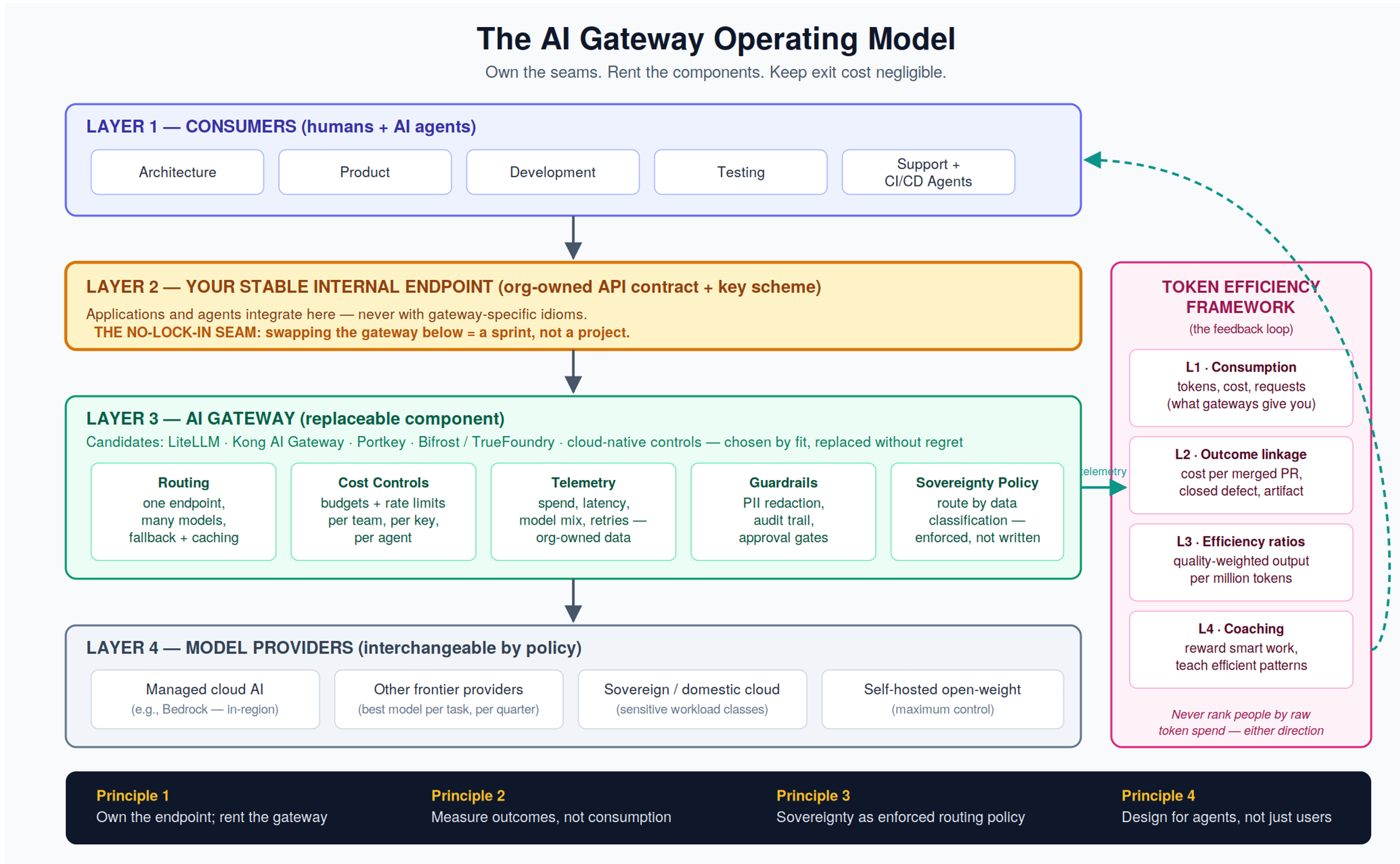
- Layer 1 — Consumers. Every human team and every AI agent (coding agents, test generators, CI/CD pipelines). Design for agents from day one — they will soon generate most of your traffic.
- Layer 2 — Your stable internal endpoint. An org-owned API contract and key scheme. Applications integrate here, never with any gateway’s proprietary idioms. This is the no-lock-in seam: swapping the gateway underneath is a sprint, not a migration project.
- Layer 3 — The AI gateway (replaceable component). Whatever product you choose must deliver five functions: routing (one endpoint, many models, fallback, caching), cost controls (budgets and rate limits per team, key, and agent), telemetry landing in your database, guardrails (PII redaction, audit, approval gates), and sovereignty policy (routing by data classification).
- Layer 4 — Model providers, interchangeable by policy. Managed cloud AI in-region, other frontier providers, sovereign clouds, self-hosted open-weight models. The best model for a task changes quarterly; the abstraction compounds in value every quarter.
- The feedback loop — the Token Efficiency Framework. Telemetry flows into outcome-linked metrics; insight flows back to teams as coaching. This loop is where value-over-spend becomes real.
Four operating principles: (1) Own the endpoint; rent the gateway. (2) Measure outcomes, not consumption. (3) Sovereignty is an enforced routing policy, not a paragraph in a document. (4) Design for agents, not just users.
Measuring Smart Work: The Token Efficiency Framework
Gateways ship consumption metrics. Value must be constructed on top of them, in four layers:
- L1 — Consumption (out of the box). Tokens, cost, requests, model mix — per team, key, and use case. Necessary, radically insufficient.
- L2 — Outcome linkage. Tag AI usage to work items in your delivery tooling. Report cost per merged pull request, per closed defect, per accepted document — not the cost per person.
- L3 — Efficiency ratios. Quality-weighted output per million tokens; first-pass acceptance rate of AI-assisted work; rework rate on AI-generated code.
- L4 — Coaching. Surface what your most efficient practitioners do differently — context discipline, model-tier selection, low retry ratios — and teach it deliberately. Reward the judgment, replicate the pattern.
Guardrails (non-negotiable)
- Never rank people by raw token spend — in either direction. Punishing spend suppresses legitimate experimentation; rewarding it subsidizes brute force.
- Expect Goodhart’s Law: any single ratio will be gamed. Use a balanced set, reviewed quarterly.
- Be transparent with staff about what telemetry exists and how it is used. In public-sector and unionized environments this is the difference between a productivity practice and a surveillance grievance.
No Lock-In: Engineering Exit Cost Toward Zero
Most gateway evaluations compare features. The more important question is: what does it cost to leave? The AI gateway market is roughly 1.5 years old and consolidating; welding the architecture to any single product — open-source or commercial — is a mistake. Engineer the exit instead:
- Applications never see the vendor. All integration targets your internal endpoint and key scheme; a gateway swap changes configuration, not application code.
- Telemetry lives in your database. Spend history and audit logs export continuously to org-owned storage. Losing the gateway must never mean losing the data.
- Policies are declared, not embedded. Budgets, routing rules, and data classifications live in version-controlled configuration re-expressible in another product in days.
- Test the exit annually. Run a second gateway or the cloud-native controls behind the same endpoint for one workload. If the swap takes more than a sprint, the seam has drifted — fix it.
Under these conditions, the product decision becomes low-stakes. The candidates below reflect my own evaluation cross-checked against the Q2-2026 gateway landscape analyses and provider documentation:
| Candidate | Model | Typical fit |
|---|---|---|
| LiteLLM | Open-source, self-hosted (open-core) | Broadest provider coverage and cost-control primitives; strong candidate for teams with DevOps depth. Trade-offs: operational burden, paid tier for SSO/RBAC/audit, throughput ceilings at high concurrency. |
| Kong AI Gateway | Extends Kong API platform | Enterprise governance pedigree (RBAC, audit, on-prem); natural for organizations already invested in Kong. |
| Portkey | Managed SaaS | Guardrails and compliance features with low setup; adds a SaaS processor to every request — weigh against sovereignty needs. |
| Bifrost / TrueFoundry | Self-hosted, performance-oriented | Very low latency overhead, Kubernetes/VPC-native; younger ecosystems. |
| Cloud-native controls | Managed provider features | e.g., inference profiles for cost tagging, intelligent prompt routing, prompt caching. Simplest path; single-cloud scope. These sit below a gateway and stack with it. |
Sovereignty as Routing Policy
For public-sector and regulated organizations — especially in Canada and the UAE, where I practise — the gateway is also a jurisdiction control point. Canada’s 2026 national AI strategy and Sovereign AI Compute Strategy treat AI infrastructure as national policy: federal investment in domestic compute, sovereign data-centre programs requiring Canadian location and governance, and federal departments prioritizing sovereign-cloud hosting for sensitive workloads.
- Residency is not sovereignty. Data in a foreign hyperscaler’s Canadian region is resident but remains exposed to extraterritorial legal frameworks. Sovereignty adds domestic control, governance, and access rights.
- A self-hosted gateway adds no foreign data processor to your AI traffic; a SaaS gateway adds one to every request. Prompts and completions routinely contain sensitive operational data.
- Make it enforceable: classify workloads by sensitivity, then let the gateway enforce routing — public information to any approved model; sensitive classes to in-region, sovereign, or self-hosted endpoints only.
- Configuration and gateway logs are sensitive records themselves. Keep them in your jurisdiction, under your retention policy.
Framed this way, sovereignty is not a compliance tax — it is one more argument for the same architecture: an org-owned seam with interchangeable providers behind it.
Why This Matters More Every Quarter: The Agentic Future
Industry research through 2026 converges on one picture: software delivery is shifting from “humans writing code with AI assistance” to humans orchestrating agents that execute end-to-end work — planning, coding, testing, documenting, deploying. Four consequences:
- Traffic explodes. One human task becomes dozens of agent steps, each a model call. Token governance becomes a load-bearing financial control, not a dashboard.
- The unit of measurement shifts from person to agent-task. Cost per outcome — exactly what the Token Efficiency Framework produces — becomes the only sane lens.
- The gateway becomes a control plane for non-humans: agent identities, per-agent budgets, tool-call governance, human-approval gates, and even kill switches. Evaluate every candidate on its agent-governance roadmap, not just user features.
- Human value concentrates in judgment — problem definition, design, review. A value-over-spend measurement culture rewards exactly what remains scarce.
Way Forward
Next 6 months — Prove and instrument
- Deploy a gateway behind your own stable endpoint; issue keys with per-team budgets and rate limits.
- Publish spend dashboards openly — transparency alone changes behavior.
- Enable provider-level optimizations (prompt caching, intelligent model routing); they stack with the gateway.
- Define workload sensitivity classes and enforce them as routing rules.
- Pilot outcome tagging (L2) with one or two teams.
6–12 months — Govern and educate
- Roll out efficiency ratios (L3) across functions; run quarterly “efficient practice” reviews.
- Deliver targeted prompt/context training based on what the data reveals (oversized contexts, retry storms, wrong model tiers).
- Add a second provider behind the endpoint to prove the abstraction is real, not theoretical.
- Extend coverage to CI/CD and test pipelines; formalize guardrails, audit retention, and staff communication.
1–3 years — Scale to agents
- Extend budgets, identities, and approval gates to agents; add kill switches for autonomous workflows.
- Shift primary reporting to cost-per-outcome; feed efficiency data into estimation and capacity planning.
- Re-evaluate the gateway market annually; exercise the swap option without sentiment if a better fit emerges.
- Route sensitive workload classes to sovereign or self-hosted endpoints.
Long term — The seam outlives the components
- Expect the “AI gateway” category to dissolve into broader platform engineering. Owning a clean endpoint and clean telemetry means riding that consolidation rather than being restructured by it.
- The gateway corpus — what was asked, what it cost, what outcome it produced — becomes institutional memory: raw material for internal benchmarks, fine-tuning, and codified best practice.
- The durable advantage is cultural: reward judgment per token, not effort in tokens.
Conclusion
Do not ask “which gateway should we buy?” Ask “which seams must we own so that the answer never matters much?” Own the endpoint, the telemetry, and the measurement culture; rent the gateway and keep the exit door permanently ajar. Then point the whole apparatus at the question that actually determines return on AI investment — not how much AI are we using, but how intelligently are we using it. The organizations that learn to see — and reward — the second developer will out-build the ones still celebrating the first.
References
- TrueFoundry, “A Detailed LiteLLM Review: Features, Pricing, Pros and Cons,” 2026.
- Eden AI, “Top LiteLLM Alternatives in 2026: Compared by Cost, Performance & Features,” 2026.
- Maxim AI, “Top 5 LiteLLM Alternatives in 2026,” 2026.
- Techsy, “Best LLM Gateway 2026: 9 Tools Ranked & Tested,” 2026.
- Amazon Web Services, “Application Inference Profiles,” Amazon Bedrock User Guide.
- Amazon Web Services, “Understanding Intelligent Prompt Routing in Amazon Bedrock,” Amazon Bedrock User Guide.
- Amazon Web Services, “Reduce Costs and Latency with Amazon Bedrock Intelligent Prompt Routing and Prompt Caching,” AWS News Blog.
- Anthropic, “2026 Agentic Coding Trends Report,” 2026.
- Forrester, “The State of Agentic Software Development, 2026,” 2026.
- Osler, Hoskin & Harcourt LLP, “Data Sovereignty: Looking to the Past as Canada Decides How to Move Forward,” 2025.
- Torys LLP, “Canada Promotes Investment in Sovereign, Large-Scale AI Data Centres,” January 2026.
- Borden Ladner Gervais LLP, “Canada’s New AI for All Strategy: A Business Outlook on AI Governance, Adoption, and Data Sovereignty,” June 2026.
- Innovation, Science and Economic Development Canada, “Enabling Large-Scale Sovereign AI Data Centres,” Government of Canada, 2026.
- Shared Services Canada, “2026–27 Departmental Plan,” Government of Canada, 2026.